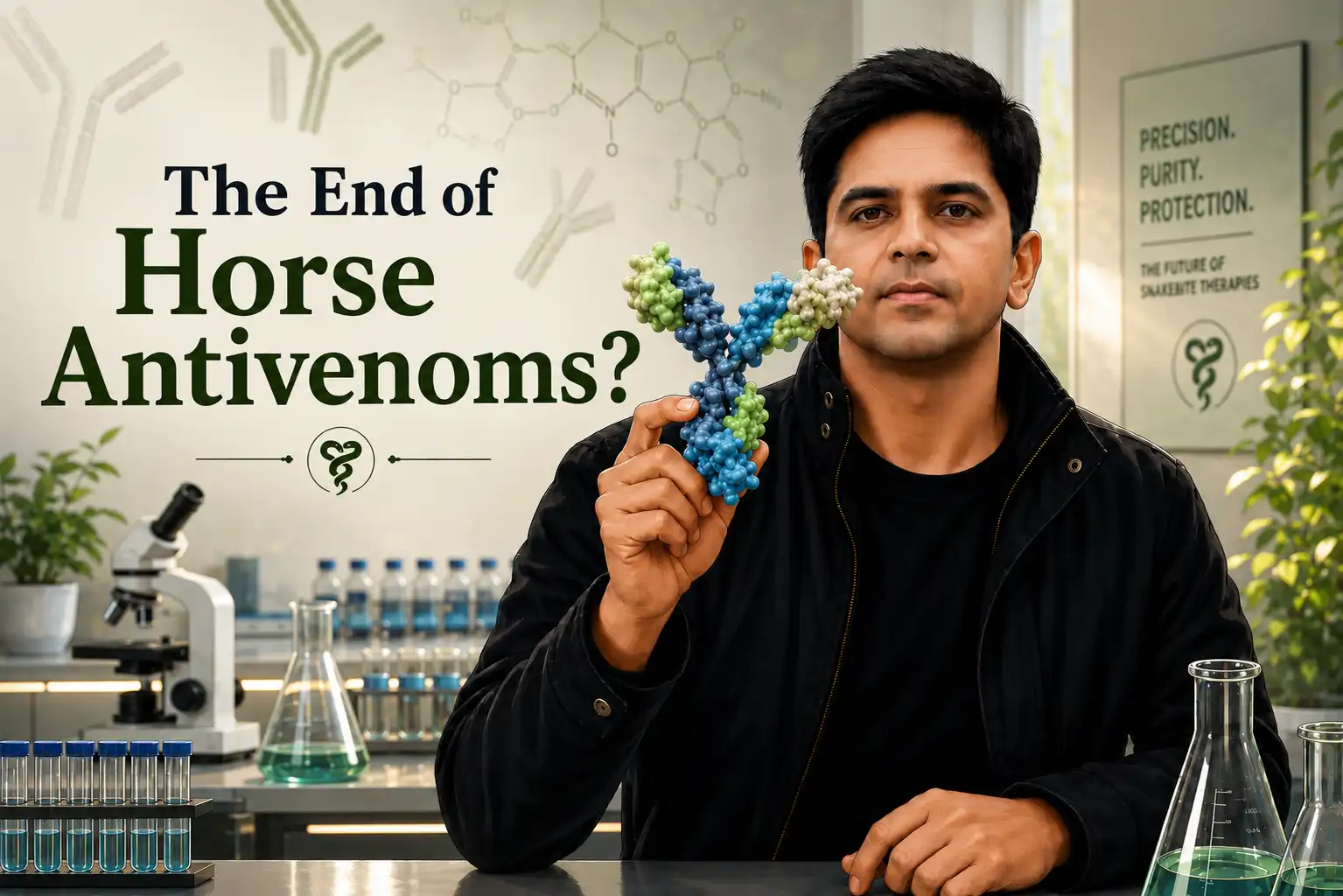
If you've ever seen how antivenom is made, it almost feels like stepping back in time.
We inject horses with tiny doses of snake venom over many months. Their immune system builds antibodies against it, we collect the blood, purify the antibodies, and eventually the product reaches a hospital shelf.
It works. It has saved a great many lives over the past century.
But the method hasn't changed much since the late 1800s.
Which raises an obvious question. Can we do better?
I think we can.
The mixture in the vial
One of the biggest misconceptions about antivenom is that it's a single, highly specific drug. It isn't.
A vial holds thousands, maybe millions, of different antibodies. Only about one in ten actually recognises the toxins that make someone sick. The rest are along for the ride.
Along for the ride, but not harmless. Push enough foreign protein into a person and it can bring on serum sickness, or the anaphylaxis that sometimes kills.
That's part of why patients often need several vials. It's also why antivenoms can trigger allergic reactions. You're putting a large quantity of horse protein into a person, and most of it does nothing useful.
Now imagine swapping that whole mixture for a handful of human antibodies, each one picked because it neutralises a toxin that matters.
That's the idea behind synthetic or recombinant antivenoms.
Betting on evolution
A couple of years ago, collaborators from The Scripps Institute and my lab at IISc, set out to test whether it could actually be done.
Instead of immunising animals, we built a synthetic library of roughly 60 billion unique human antibodies, creating a diversity that no natural immune system could ever generate. Not one of them had ever met snake venom. They were just raw molecular diversity.
Somewhere in that pile, we hoped, sat antibodies that could recognise toxins evolution has kept nearly identical across very different snakes.
The odds weren't in our favour.
Evolution was.
The one thing venom couldn’t change
We went after long-chain α-neurotoxins, one of the main killers in cobras, king cobras, kraits and mambas (also happens to be my most favourite toxin).
These toxins work in a specific way. They latch onto receptors on muscle cells and cut the line between nerve and muscle, paralysing the lungs, until the victim can't breathe.
The snakes that make these toxins are separated by millions of years. But every one of these toxins still has to bind the same receptor. So, one small patch on the toxin can't drift far without breaking the toxin itself.
That patch was our target.
Rather than hunting for an antibody against one cobra toxin, one krait toxin, or one mamba toxin, we looked for the one that recognised the feature none of them could afford to lose.
We screened billions of candidates and found it. Then we made it better.
Then came the real test
Finding an antibody is only half the job. But does it work?
It did.
It worked by binding the toxin directly, blocking it from reaching the receptor it targets in the body. It protected mice against purified neurotoxins and against whole venoms from several medically important snakes, cobras and black mambas among them. When we delayed treatment until after envenoming, in the kind of rescue experiment that actually mirrors a bite, it still held up.
For the first time it felt like recombinant antibodies could be a real alternative to the horse antivenom.
When everything clicked
Finding an antibody that neutralised these toxins was exciting. Understanding why it worked was better still.
The antibody blocked long-chain α-neurotoxins from binding their target receptors. That's the mechanism behind the protection we'd already seen hold up in mice. We later refined it further, pushing up both affinity and potency.
Then came the moment every structural biologist hopes for.
We solved the structure of the antibody bound to its target.
Only then did we understand why it worked so well.
The antibody wasn't recognising just any part of the toxin. It had latched onto the very surface the toxin uses to bind our own receptor, a region evolution had left the toxin almost no room to change without losing function.
Our antibody had arrived at the same solution.
Seeing the structure was one of those rare moments when years of work suddenly made sense. The screen had found a winner by experiment. The structure just explained why.
Not a universal antivenom
Before anyone runs the "universal antivenom" headline, a reality check.
Snake venoms are messy. Very messy.
Cobra venom is far more than one toxin. Viper venoms are worse, dozens of proteins going after completely different parts of the body.
One antibody was never going to solve snakebite. It was never meant to.
The endgame isn't signing Batman and calling it a day. It's building the Justice League: each antibody has one job, and together they cover the toxins that actually matter. That's a more deliberate way to build an antivenom than leaving a horse's immune system to guess.
What comes next
We haven't slowed down since this came out. If anything the opposite.
The lab, together with our incredible collaborators around the world, has been developing recombinant antibodies against some of the world’s most medically important snakes, including the spectacled cobra, the king cobra,the monocellate cobra, and the Russell’s viper, the species responsible for more snakebite deaths and disabilities than any other.
A few of the results have surprised even us.
I can't say much yet.
But I don't think you'll be waiting long 🙂
Paper: Khalek IS, Senji Laxme RR, Nguyen YTK, Khochare S, Patel RN, Woehl J, Smith JM, Saye-Francisco K, Kim Y, Mindrebo LM, Tran Q, Kedzior M, Bore E, Limbo O, Verma M, Stanfield RL, Menzies SK, Ainsworth S, Harrison RA, Burton DR, Sok D, Wilson IA, Casewell NR, , Jardine JG*. Synthetic development of a broadly neutralizing antibody against snake venom long-chain alpha-neurotoxins . Science Translational Medicine. 2024;16:eadk1867.
* Corresponding authors
Comments