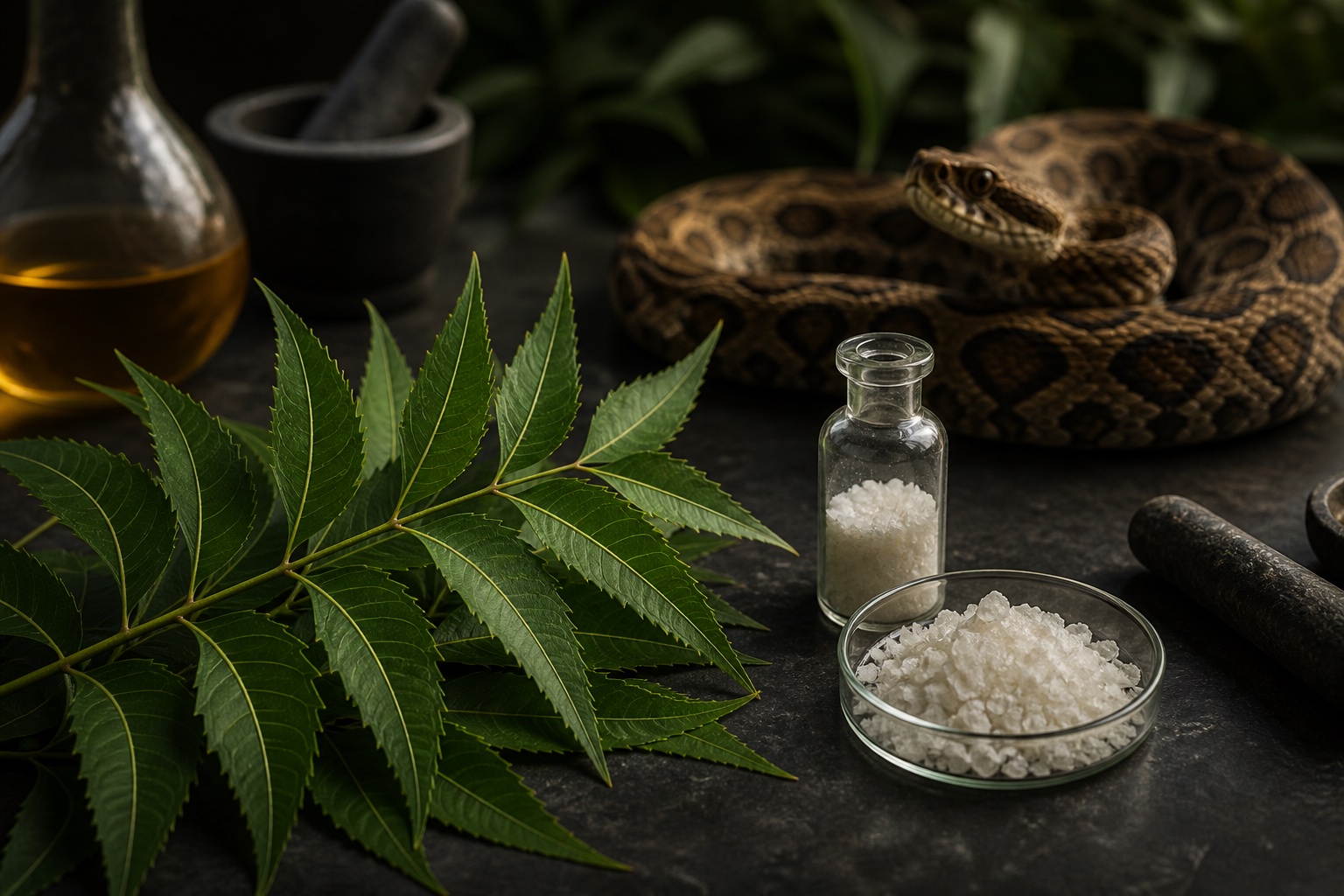
Russell's viper kills more people in India than any other snake. Delayed access to hospitals is part of the problem, and so is the venom itself: even when antivenom arrives in time, it often can't stop the bleeding, swelling, and tissue death happening right at the bite site. Many patients who survive lose the limb anyway. That gap between "alive" and "whole" is what our new paper in Toxicon tries to chip away at.
What antivenom leaves behind
Antivenom has three main weaknesses. It's raised against venom from one snake population, so it can miss the mark against venom from a different part of the country. It's expensive to make, and it's built to mop up venom systemically through the bloodstream, which means it does little for the local damage happening in the muscle and skin around the bite. Necrosis, haemorrhage, oedema: these are often what cost people their fingers, hands, or feet, and antivenom barely treats them.
Long before any of this had a name, the Irula community of Tamil Nadu in southern India had their own answer. Snakebite treatment using local plants has been part of Irula practice for generations, alongside their better-known role as India's expert snake catchers. We wanted to know whether any of that knowledge held up under a microscope.
Ten plants under the microscope
So we tested ten plants the Irula traditionally use for snakebite against Russell's viper venom. We ran them through a panel of assays measuring the venom's ability to digest protein, chew through blood vessels, kill muscle cells, and stop blood from clotting properly. Then we checked whether the extracts could prevent toxicity and lethality of mice.
Three plants stood out: neem (Azadirachta indica), a worm-killer vine called Aristolochia bracteolata, and Indian whitehead (Enicostemma axillare). All three blocked venom-induced haemorrhage by 95 to 99 percent when mixed with venom before injection. For context, the commercial antivenom we tested alongside them managed just 29 percent, and in some of the enzyme assays it showed almost no inhibitory activity at all. Antivenom works mainly by clearing venom from the bloodstream by binding to it, and often, not by switching off the enzymes doing the damage locally. Plant compounds or phytocompounds, it turns out, can do the latter rather well.
We split each of the three extracts into smaller and smaller fractions using column chromatography until we found the most active one from each plant. When this fraction from neem or Indian whitehead was mixed with a two-and-a-half-times the lethal dose of venom before injecting mice, every animal survived. The equivalent fraction from the worm-killer vine stopped local tissue damage just as well but didn't save a single mouse from the challenge dose of venom, a reminder that blocking local damage and blocking systemic lethality aren't the same fight.
The acne cream outsider
Chemical analysis of neem's active fraction turned up 240 compounds. We narrowed the list to four for closer testing: gallocatechin, catechin, and quercetin, all previously known to interfere with snake venom enzymes, plus one outsider, azelaic acid. Azelaic acid's day job is treating acne and rosacea. Nobody had tested it against snake venom before.
It turned out to be the standout. Azelaic acid was the only one of the four compounds that fully blocked the venom's protein-digesting enzyme, and the only one that also corrected the venom's disruption of blood clotting. Mice given a lethal venom dose preincubated with azelaic acid survived over a hundred times longer than untreated controls, and the effect scaled up with dose. It didn't save every animal, but for a first-in-class discovery from an acne cream ingredient, that's a reasonable place to start.
There's a catch worth sitting with. Azelaic acid alone never matched what the whole neem fraction achieved, which fully protected every mouse. Something about the mix of compounds in the crude fraction works better together than any single piece does alone, a hint that these plants may owe their effect to several molecules acting in concert rather than one hero ingredient.
From a lab result to first aid
Delivery route mattered too. Injecting the active fraction into the abdomen after a venom challenge worked better than injecting it into a vein, and both beat swallowing it. Oral dosing is the most practical option for a rural first-aid scenario (see: A pill against Snakebite), and it was also the weakest, almost certainly because the compounds get broken down in the gut before they reach the bloodstream. That's a real obstacle for anyone imagining a field-ready product.
None of this means you should reach for a neem leaf poultice after a snakebite. Antivenom remains the only treatment with real clinical evidence behind it, and it is the only thing to seek out after a bite.
These results come from mice and lab assays, not people, and crude plant extracts carry their own risks at the doses that show activity. Antivenom, however imperfect, remains the only treatment with real clinical evidence behind it. What this study offers is a lead: a validated, first-of-its-kind snake venom inhibitor sitting in a plant that traditional healers have relied on for a long time, and a case for taking that knowledge seriously enough to test it properly rather than dismiss it.
Paper: Navanita S, Rudresha GV, Samanta A, Nayak M, Selvaraj H, Raman R, and . Leaf to life: Harnessing medicinal plants as inhibitors of Russell's viper venom. Toxicon. 2026.
Comments