When most people hear the word venom, they think of snakes, spiders, or scorpions. Very few would picture a bat.
And yet one of the world's most extraordinary venoms belongs to a mammal.
Not because it kills.
Because it lets its owner steal blood without its victim noticing.
Imagine sleeping peacefully in a South American pasture. A bat lands beside you. It doesn't attack. It doesn't tear flesh. Instead, it makes a tiny incision only a few millimetres deep using razor-sharp teeth. The cut is so small that many animals never wake up.
Then something odd happens.
The wound refuses to clot.
Blood keeps flowing for twenty or thirty minutes while the bat laps it up with its tongue before quietly disappearing into the night.
The secret isn't the bite.
It's the chemistry.
The saliva of vampire bats contains a cocktail of molecules that manipulate their victim's physiology with startling precision. Blood vessels stay open. Platelets fail to stick together. Blood clots dissolve almost as quickly as they begin to form. Every component works together to keep the meal flowing.
By the scientific definition, that's venom. Most people simply don't realise it.
We thought we knew this venom
When I first started working on vampire bats, scientists believed they already understood their venom fairly well. Almost all the attention had focused on just two proteins.
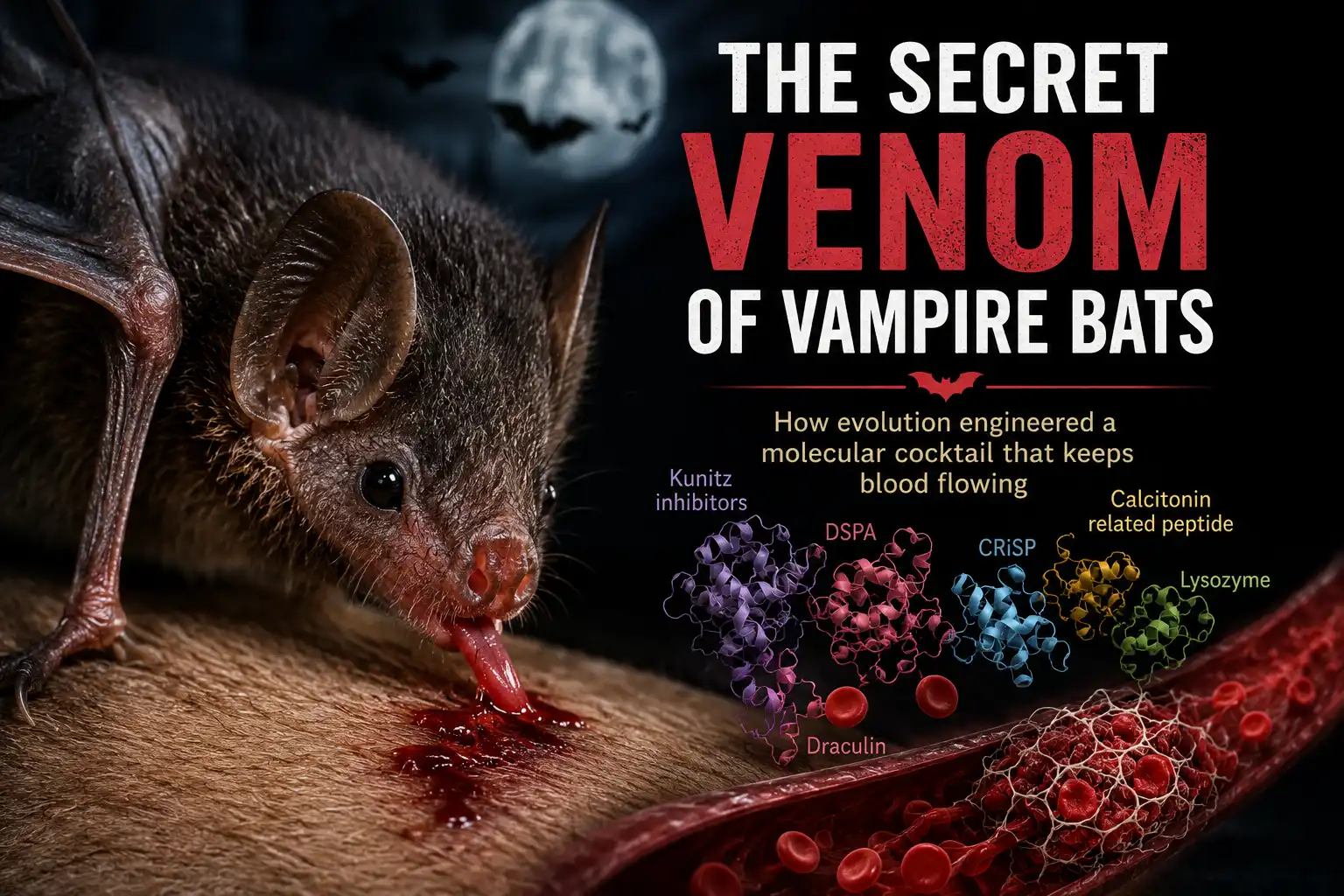
The first was draculin, appropriately named after Bram Stoker's famous vampire. It blocks key clotting factors in the blood, preventing a stable clot from forming.
The second was Desmodus salivary plasminogen activator, mercifully abbreviated to DSPA. This protein actively dissolves blood clots that do manage to form. One version of DSPA attracted so much attention that it was developed as a potential treatment for stroke, where dissolving dangerous blood clots can save brain tissue.
These two proteins were famous. It seemed reasonable to assume they were the stars of the 'horror' show.
Our study asked a simple question. What if there was much more hiding in vampire bat venom than anyone had realised?
Looking beyond the usual suspects
Rather than studying one protein at a time, we decided to examine the entire venom system. We sequenced the genes being expressed in the bat's venom glands, then identified the proteins actually present in the saliva. In other words, we weren't just reading the instruction manual: we were checking which molecular tools the bat was actually using.
What emerged was far more complicated than anyone expected. Instead of two important proteins, we found an entire biochemical arsenal.
Some belonged to familiar toxin families already known from snakes and other venomous animals. Others had never before been recognised as components of vampire bat venom. The saliva contained molecules related to Kunitz inhibitors, kallikreins, cysteine-rich secretory proteins (CRISPs), calcitonin, pituitary adenylate cyclase-activating peptide (PACAP), lysozyme, secretoglobins, lipocalins, and several other peptide families, each with the potential to influence blood flow, inflammation, immunity, or tissue function.
The more we looked, the less this resembled a simple anticoagulant. It looked more like an entire pharmacy.
Evolution keeps solving the same problem
One of the most fascinating aspects of venom evolution is that nature rarely starts from scratch. Instead, evolution borrows.
An ordinary protein that once served an everyday function in the body gets copied. One copy continues doing its original job. The other is free to accumulate mutations. Over millions of years, that duplicate can become something entirely different: a toxin.
That's exactly what we saw in vampire bats. Many of the proteins we identified were descended from completely ordinary mammalian proteins, yet evolution had repurposed them into molecules that help a bat feed on blood.
What I find striking is that many of these proteins are familiar to all of us. You and I produce related versions in our saliva, tear glands, reproductive tissues, immune system and many other parts of the body, where they perform perfectly ordinary housekeeping roles.
In vampire bats, however, evolution has rewritten their job descriptions. The same molecular building blocks have been transformed into an elegant cocktail that prevents blood clotting, widens blood vessels and keeps a meal flowing.
Odder still: some of these protein families had independently evolved into toxins elsewhere in the animal kingdom.
Snakes had discovered them.
Cone snails recruited them.
Slow lorises repurposed them.
And vampire bats had arrived at similar solutions anyway, each through its own evolutionary path.
Different animals. Different ancestors. The same molecular ideas.
Evolution can be astonishingly inventive, but it also has favourite tricks.
An evolutionary arms race
Our study wasn't just about identifying proteins. We also wanted to understand how they had evolved over millions of years. The answer turned out to be more dynamic than we expected.
Many of the venom proteins showed clear evidence of positive selection, an evolutionary process that favours beneficial mutations. Unlike their counterparts in most other mammals, which have stayed almost unchanged for millions of years, these venom proteins were evolving rapidly, generating a surprising amount of diversity within vampire bat populations.
Why would evolution favour so much variation?
Imagine being a cow that is bitten repeatedly by vampire bats living in the same area. Over time, your immune system might begin recognising the proteins in their saliva and develop resistance, making it increasingly difficult for those bats to feed successfully.
Natural selection favours a different strategy. Instead of every bat producing exactly the same venom proteins, populations contain many subtly different versions. The core parts of these proteins, the regions responsible for their biological function, remain highly conserved, while the exposed surfaces accumulate mutations much more rapidly. These changes alter the molecular “appearance” of the proteins without compromising what they do.
The result is a constantly shifting biochemical landscape across the population. By maintaining diversity in their venom components, vampire bats may make it much harder for prey animals to develop broad immunity against their salivary toxins.
It's a strategy seen across the venomous world. Vampire bats have simply evolved their own version of it.
From rainforest to medicine
At first glance, vampire bat venom might seem like little more than a biological curiosity. In reality, it's exactly the sort of chemistry that drug discovery loves.
Nature has spent millions of years refining molecules that prevent clotting, dissolve fibrin, alter blood flow, regulate inflammation, and interact with the immune system. These are the processes that go wrong in heart attacks, strokes, thrombosis, and many other human diseases.
Desmoteplase, derived from vampire bat venom, was developed as a clot-dissolving drug and taken into human trials, a sign of how far these molecules can travel from an animal's saliva toward medicine. Our work suggested that it may only be the beginning. Hidden among the newly discovered proteins could be entirely new classes of therapeutic molecules waiting to be understood.
The real Dracula
For centuries, vampire bats have inspired myths, horror stories, and the legend of Dracula. The truth, as it often does, turns out to be even more interesting.
These small mammals don't rely on brute force. They rely on precision.
Their saliva is the product of millions of years of evolutionary fine-tuning: a carefully balanced mixture of molecules that manipulate one of the most complex physiological systems in the body.
When we began this project, we thought we were studying two famous proteins. Instead, we uncovered an entire molecular toolkit.
More than a decade later, that's still what keeps me hooked on venom research. Every time we look closely at an overlooked animal, evolution has another surprise waiting for us.
Sometimes, the next breakthrough in medicine isn't hiding in a laboratory.
Sometimes, it's flying silently through a rainforest after sunset.
A personal note
This study will always stay with me.
Partly because it focussed on CRISPs, one of my favourite toxin families. My first paper in venom biology explored the evolution of CRISPs and was published in Molecular Biology and Evolution , a journal many young PhD candidates aspire to publish in.
But the bigger reason is the people. This was one of the first projects I worked on as a PhD student with Dr Bryan Fry at the University of Queensland, the legendary venom biologist many know simply as the Venom Doc.
At the time I thought I was helping unravel the secrets of vampire bat saliva. I didn't realise I was also reshaping my own understanding of venom. More than a decade later, that lesson still guides my research. Venom isn't defined by fangs or stingers. It's defined by function. And some of nature's most extraordinary venoms come from the animals you'd least suspect.
Comments