It is always fascinating to look closely at widespread species in the wild. Some animals occur in one small forest, one mountain range, or one island. Others seem to be everywhere.
The spectacled cobra, Naja naja, belongs to the second category.
In India, this snake is found across an extraordinary landscape: from Kanyakumari to Kashmir, from the humid east to the dry west, from agricultural fields and rocky scrublands to villages, forest edges, and city outskirts. Few snakes are as familiar, feared, revered, and misunderstood as the Indian spectacled cobra.
But familiarity can be deceptive.
Over the last few years, our work on Indian cobras has shown that this is not a uniform snake. Cobras from different parts of the country can look different. Some have bold spectacle marks on the hood, others have faint markings, and some may appear quite different in colour and pattern. Their venoms also vary dramatically across geography. A cobra from one region may have a venom composition that is meaningfully different from a cobra elsewhere.
This naturally raises an exciting evolutionary question:
Are all these cobras really one widespread species, or are there hidden species concealed under the familiar name Naja naja?
Why this question matters
This is not just a matter of naming snakes.
When a species is spread across a vast area, populations can become separated by rivers, mountains, deserts, climate, or sea-level changes. Over thousands or millions of years, these isolated populations may evolve independently. Eventually, what we once called one species may turn out to be several.
This has happened repeatedly in reptiles. Many “common” or “widespread” species have later been shown to contain cryptic diversity: hidden evolutionary lineages that look similar but have distinct genetic histories.
For medically important snakes, this question becomes even more important. If different populations have different venoms, different evolutionary histories, or different levels of relatedness, that knowledge can influence how we think about antivenom, conservation, and snakebite biology.
So, in this study, we asked a simple but powerful question: what is the evolutionary story of the Indian spectacled cobra?
Reading history from DNA
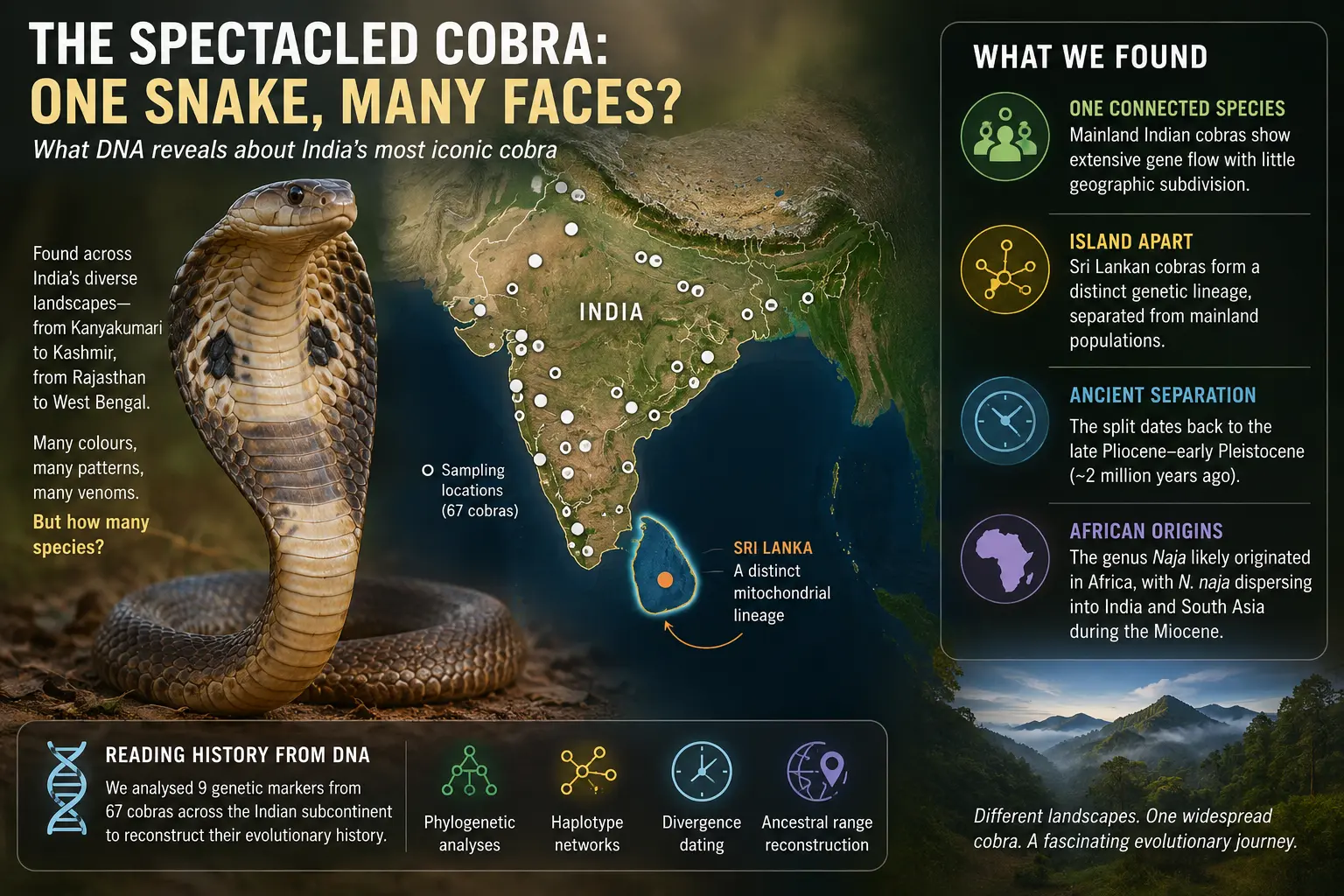
Instead of relying only on appearance, we turned to DNA. In this study, we sequenced nine nuclear and mitochondrial genetic markers from 67 spectacled cobras collected across the major biogeographical regions of the Indian subcontinent. We also included previously published data, bringing the total dataset to nearly 100 Naja naja sequences from across the Indian subcontinent. This allowed us to ask whether Indian Naja naja is one widespread species, or whether several hidden lineages are concealed under the same name.
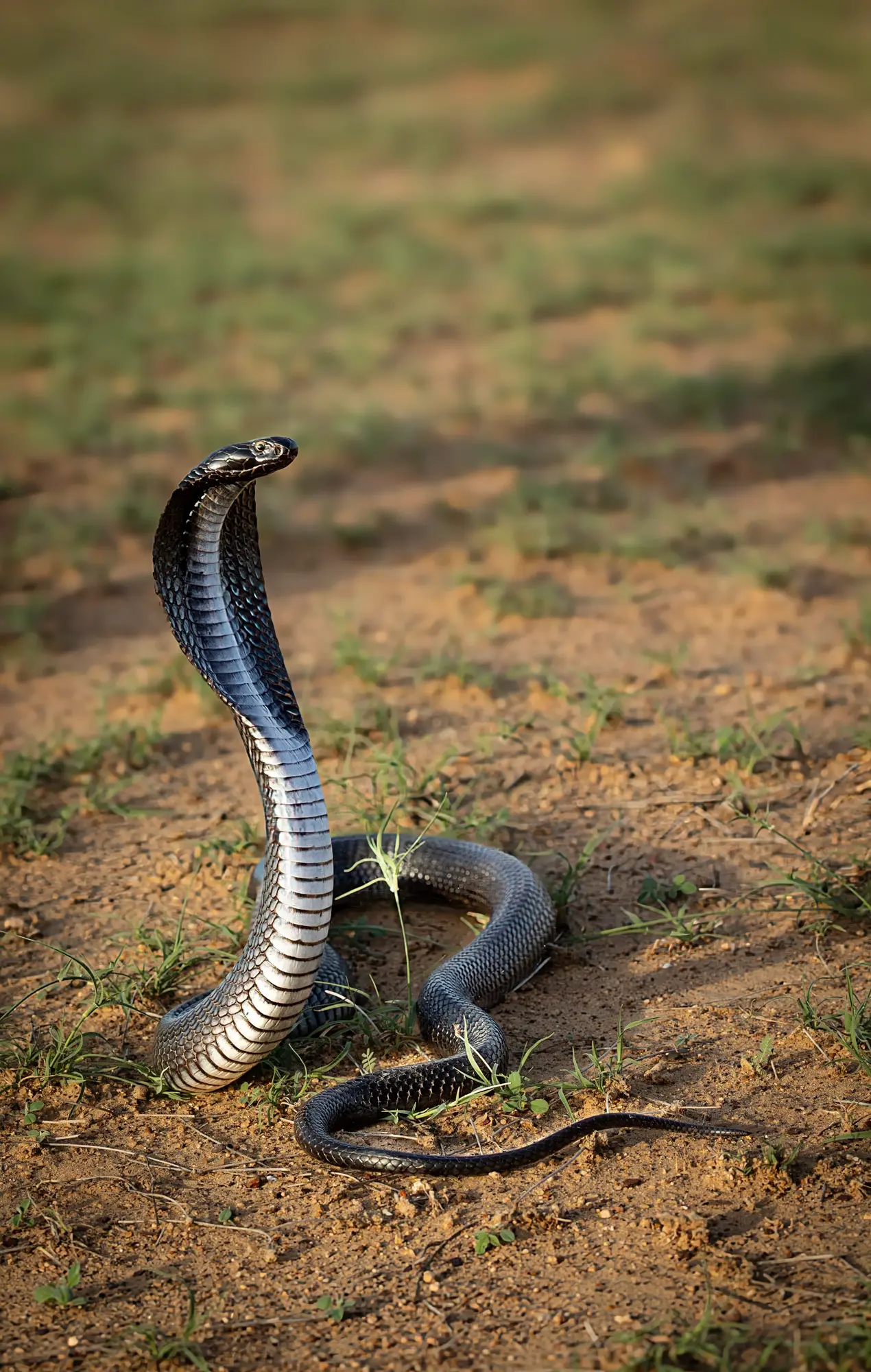
We expected that a snake distributed across such a huge and ecologically diverse region might show strong geographic structure. Take Rajasthan population, for example. One might expect cobras from this landscape to form their own genetic group, distinct from cobras elsewhere in India. After all, just look at them. Many are metallic jet black, and when one raises its hood in the golden light of Rajasthan, you truly appreciate the beauty and presence of a cobra.
But the result was surprising.
Across mainland India, the spectacled cobra appears to be largely one connected genetic population. Despite all the visible variation in colour, markings, ecology, and venom, the genetic data did not support the presence of multiple deeply separated species within mainland Indian Naja naja.
In other words, the Indian spectacled cobra is spectacularly variable — but not necessarily a complex of many hidden species across mainland India.
Why do we see this pattern?
So why do cobras across mainland India remain so genetically similar, despite living in very different places?
One reason may be that cobras move well. They are not restricted to one tiny patch of habitat. Over time, individuals can move across landscapes, and when animals from different regions occasionally breed with each other, their populations remain genetically connected.
Humans may also have played a small role. Cobras have long been moved around India through snake-charming traditions, the pet trade, and accidental or intentional transport. This may have mixed some populations.
But human movement alone is unlikely to explain the whole story. The simpler explanation is that Naja naja is naturally good at staying connected across large landscapes.
So, while Indian spectacled cobras may look different in different regions, they still appear to share a largely connected evolutionary history across mainland India.
The Sri Lankan surprise
The story changes when we look at Sri Lanka.
Sri Lankan spectacled cobras formed a distinct mitochondrial lineage, separate from mainland Indian populations. This suggests that the island population has had its own evolutionary history, shaped by geographic isolation.
This makes sense when we consider the deep-time geography of South Asia. India and Sri Lanka have not always been separated in the same way they are today. Sea levels have risen and fallen repeatedly over geological time. During periods of low sea level, land connections may have allowed animals to move between India and Sri Lanka. During high sea levels, those connections disappeared, isolating populations.
Our analyses suggest that the split between the Sri Lankan and mainland Indian lineages may date back to roughly two million years ago, around the late Pliocene to early Pleistocene. That is a long time for an island population to follow its own evolutionary path.
How did cobras reach India?
The story of the Indian cobra begins far away from India.
The cobra genus, Naja, likely originated in Africa millions of years ago. From there, different cobra lineages spread into other parts of the world. Some moved toward Europe, while the ancestors of Asian cobras appear to have taken another route — through the Middle East and into Asia.
Around 10 million years ago, changing climates and shifting landscapes may have opened up dry corridors of habitat that allowed these snakes to move out of Africa. Eventually, one ancestral cobra lineage reached the Indian subcontinent.
Once here, it gave rise to the spectacled cobra, Naja naja. From India, this lineage appears to have spread widely — south into peninsular India, north and northwest into drier regions, and east toward northeastern India.
Sri Lanka was likely colonised later. During periods when sea levels were lower, land bridges may have connected southern India and Sri Lanka, allowing cobras to move across. Once sea levels rose again, Sri Lankan cobras became isolated and began following their own evolutionary path.
In this sense, the Indian spectacled cobra is not just an Indian story. It is part of a much older Africa-to-Asia journey that shaped the rise of Asian cobras.
What did we learn?
The main lesson is that appearance and venom variation do not always map neatly onto species boundaries.
A cobra in one part of India may look different from a cobra elsewhere. Its venom may also be different. But genetically, mainland Indian spectacled cobras do not appear to be divided into several ancient, isolated lineages. Instead, they seem to represent a widespread and connected species that has managed to persist across very different landscapes.
At the same time, the Sri Lankan population stands apart and deserves closer attention.
This is what makes evolutionary biology so exciting. Sometimes, the answer is not what we expect. A snake can be highly variable in appearance and venom, yet genetically connected across a continent. Another population, separated by the sea, may carry a deeper evolutionary signature.
Why this matters beyond cobras
The spectacled cobra is not just another snake. It is one of India’s most medically important species and is responsible for a large burden of snakebite. Understanding its evolutionary history helps us make sense of its diversity.
For snakebite research, it reminds us that venom variation can evolve even within a single species. For taxonomy, it cautions us against assuming that every visible difference represents a new species. For conservation, it highlights the importance of island populations and geographically isolated lineages.
Most importantly, it shows why widespread species deserve careful study. The animals we think we know best may still hold some of the most interesting evolutionary stories.
The spectacled cobra may be one of India’s most familiar snakes, but its saga is far from ordinary.
The findings of this study are published in Molecular Phylogenetics and Evolution.
Paper: View the article on ScienceDirect.
Citation:
Dam Kanunjna, P., Gond, P. G., Unawane, A., & Sunagar, K. Spectacular Saga: Phylogenetics and phylogeography of the Indian spectacled cobra (Naja naja Linnaeus, 1758). Molecular Phylogenetics and Evolution.
Comments