Here is a question I find fascinating: does a snake's venom change as the snake grows?
In a 2024 study from the Evolutionary Venomics Lab at IISc, we looked into this in two of India's most medically important snakes: the Russell's viper (Daboia russelii) and the spectacled cobra (Naja naja). Between them, these two species cause a large share of the snakebite deaths and disabilities in the country, so understanding their venoms is a public health question as much as an evolutionary one.
To do this, we reared over 200 individuals of Russell's viper and spectacled cobra in captivity from the day they were born. We followed them through early life, collecting venom at different developmental stages and comparing these venoms with those of adults. In the study, neonates were individuals under 1 month of age, juveniles were under 12 months, and adults were over 36 months. For spectacled cobras, juvenile venoms were sampled every 3 months up to a year and compared with adult venom. It let us ask a straightforward question: do the recipe and the potency of venom change from birth to adulthood?
Venom Is Not Just Poison
Venom is often described as a toxic cocktail, but that phrase can make it sound random. It is really a carefully shaped biological tool.
For a snake, venom must do a job. It must help capture prey, begin digestion, or deter predators. Because snakes change as they grow in body size, hunting ability, and diet, it makes sense to ask whether their venom changes too.
Snakes are also gape-limited predators. This means they cannot chew, tear, or cut their food into smaller pieces. They must swallow prey whole, and the size of the prey they can eat is limited by how wide they can open their mouths. A newborn snake, therefore, lives in a very different ecological world from an adult. It cannot tackle the same prey, faces different risks, and may need a different venom strategy.
This kind of developmental change is called an ontogenetic shift. In simpler terms, it means that the venom a snake produces early in life may not be the same venom it produces as an adult.
The Russell's Viper: A Venom That Changes With Age
The Russell's viper showed a dramatic shift.
Newborn and young Russell's vipers produced venom that was dominated by toxin families such as phospholipases A2 and serine proteases. These toxins were associated with strong effects on blood and cells, and the venom of newborn vipers was especially potent in tests involving mammalian and reptilian prey.
This makes sense when we think about the life of a baby Russell's viper. Young Russell's vipers are small, gape-limited predators that cannot yet handle large prey. They are known to exhibit caudal luring, a behaviour in which the snake uses movements of its tail to attract prey. To a small lizard or frog, the wriggling tail may resemble an insect or worm. When the curious prey comes close, the viper strikes.
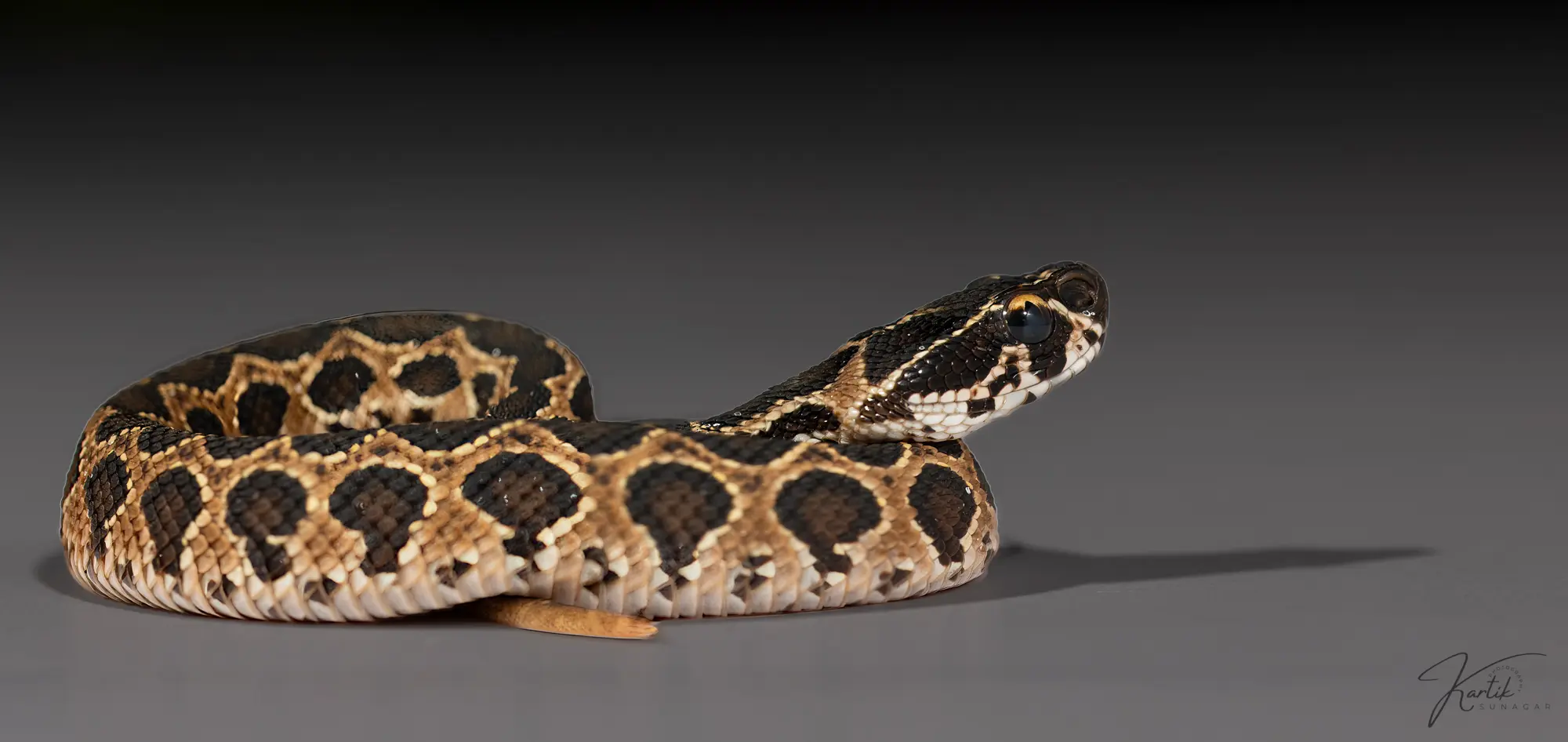
For a newborn viper, such prey can be fast, slippery, and difficult to subdue. A highly potent venom may therefore be especially useful early in life. Newborns produce very small amounts of venom, so every drop has to count.
The newborn's venom was about 2.3 to 2.5 times more potent than the mother's venom against mammalian prey.
The results with lizards were even more surprising. Adult Russell's viper venom did not kill lizards even after 24 hours, and even at doses as high as 20 mg per kg. To put that in perspective, about 5 micrograms of Russell's viper venom can be lethal to a mouse. Based on that, a 20 mg per kg dose should have been overwhelmingly potent against lizards. But it was not.
Newborn and juvenile venoms were about 20 times as toxic as adult venoms against lizards.
As the viper matured, its venom changed. Adult Russell's viper venom became more complex and contained higher proportions of toxin families linked to tissue damage, bleeding, and disruption of blood vessels. In other words, the venom shifted from a younger, highly potent biochemical toolkit to an adult venom more strongly associated with haemorrhagic and proteolytic activity.
This shift also fits what we know about diet. By analysing faecal samples of adult Russell's vipers, we know that they mostly feed on large mammals. An adult viper no longer lives in the same feeding world as a newborn. It has a larger body, a wider gape, and a very different prey base. Its venom appears to change accordingly.
One of the most interesting findings was the timing of this change. In Russell's vipers, the venom profile appeared to shift between 6 and 9 months of age. That means the snake's venom chemistry was changing quite early in life.
The Spectacled Cobra: A Venom That Stays Consistent
The spectacled cobra told a very different story.
Unlike the Russell's viper, the cobra did not show a dramatic venom transformation as it grew. Juvenile and adult spectacled cobras produced broadly similar venoms, especially in terms of their major neurotoxic components.
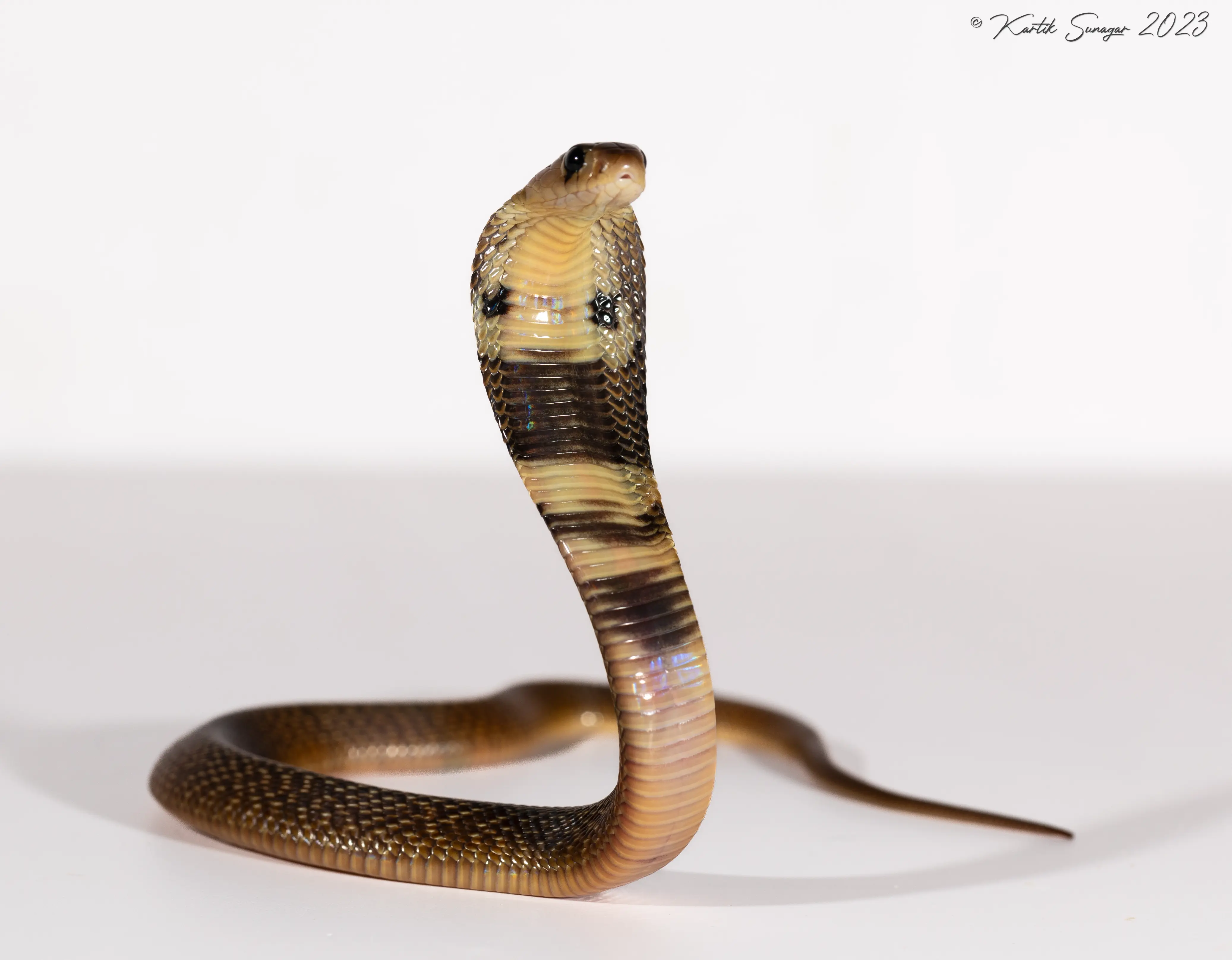
Cobra venom is strongly shaped by three-finger toxins, particularly neurotoxins that target the nervous system. These toxins interfere with communication between nerves and muscles, leading to paralysis. For a cobra, this strategy appears to remain useful across life stages.
We determined this by synthesising receptors from various prey and predatory animals of cobras, including mice, rats, frogs, lizards, birds, mongooses, and humans. These are the receptors to which cobra three-finger toxins bind.
What we found was striking. Across life stages, cobra venom bound very well to receptors from its natural prey, including rats, mice, frogs, and lizards. It bound very poorly to mongoose receptors, which makes sense because mongooses carry mutations that help protect them from cobra neurotoxins. It also did not bind well to human receptors, consistent with the fact that humans are not natural prey for cobras.
In other words, whether young or adult, the cobra's venom remained well suited for the animals it naturally hunts. This reflects an evolutionary arms race: venom evolves against the animals a snake eats or defends itself from, and humans do not feature in this race.
Why Would One Snake Change and the Other Not?
This contrast between Russell's viper and spectacled cobra is the heart of the story.
It is also surprising. Both Russell's vipers and spectacled cobras are widely distributed across India. They are often found in broadly similar habitats, from agricultural landscapes and scrublands to human-dominated environments. If both snakes live across such similar landscapes, why would venom change dramatically in one species but remain largely stable in the other?
The answer may lie in what the venom is designed to do.
The Russell's viper appears to remodel its venom as it grows because its ecological needs change with body size and prey choice. A tiny newborn viper is a gape-limited predator targeting smaller animals such as lizards and frogs, sometimes using its tail as a lure. An adult Russell's viper, by contrast, is capable of feeding on much larger mammalian prey. These are not minor dietary differences; they are entirely different hunting problems.
The spectacled cobra, however, seems to rely on a venom strategy that works across development. Its three-finger toxins target receptors that are important across its prey spectrum. Since these toxins bind effectively to the receptors of natural prey such as rodents, frogs, and lizards across life stages, the cobra may not need to dramatically change its venom as it grows.
In simple terms, the viper changes its venom wardrobe as it matures, while the cobra keeps wearing the same suit.
Why This Matters for Snakebite Treatment
These findings are not just interesting for evolutionary biology. They also matter for medicine.
Antivenoms are usually produced using venom from adult snakes. But if young snakes produce venoms that differ significantly from adults, then antivenoms raised against adult venoms may not always perform equally well against bites from younger snakes.
The study found that commercial Indian antivenoms could bind venoms from different life stages in laboratory tests, but their ability to neutralise venom in animal models was lower than expected from marketed claims. This highlights a major problem in snakebite treatment: venom variation can affect antivenom effectiveness.
To build better therapies, we need to understand venom diversity not only across geography and species, but also across age.
From Birth to Bite
A snake's venom is not frozen in time. It is shaped by life history, ecology, prey, predators, and evolution.
In Russell's vipers, venom changes dramatically as the snake grows. In spectacled cobras, it remains remarkably consistent. These two species share landscapes, encounter humans, and cause severe envenoming, yet their venom biology follows very different developmental paths.
That is the beauty and challenge of venom research. Every bite carries an evolutionary story. To treat snakebite better, we must learn to read that story from birth to bite.
Citation: Laxme S, Khochare S, Bhatia S, Martin G, Sunagar K. 2024. From birth to bite: the evolutionary ecology of India's medically most important snake venoms. BMC Biology 22, 161.
Comments