For years, the answer seemed straightforward: food. What a snake eats, how old it is, and the ecological pressures it faces, all influence its venom cocktail. My lab has spent years uncovering exactly how these living, or biotic factors, shape venom evolution. We previously showed that as Russell's vipers (Daboia russelii) grow from juveniles into adults, their venom changes dramatically to match their shifting diet (see 'When Snake Venom Grows Up'). Young snakes hunting small prey need very different biological weapons from adults tackling larger mammals.
But that left me wondering.
Does the environment itself have no role to play in shaping the venom?
We are not just talking about genetics shifting over millions of years, but the immediate ecological conditions under which populations evolve. Could snakes living in hot, dry landscapes produce different venoms from those hiding in cool, rainy forests?
That question led to one of the most ambitious studies we have ever undertaken.
Nature Shapes Every Living Being
Every organism is shaped by two kinds of force. The first are the living parts of its world: prey, predators, and competitors. The second is the physical environment itself: temperature, rainfall, humidity, and elevation.
With plants, the physical influences are obvious, since the same species grows differently in a desert and in a rainforest. In animals, we readily accept that habitat shapes body size or camouflage. Venom, though, is often treated as a fixed trait, as if the recipe were permanently locked into the snake's DNA.
In reality, venom is one of evolution's most adaptable innovations. It exists because it improves survival. Since snakes are cold-blooded ectotherms, their entire physiology is tightly bound to their environment. Climate dictates where their prey lives, how they hunt, and how their ecosystems function. It made perfect sense that climate might leave its fingerprint on venom, too.
The problem was that nobody had ever truly tested this idea in Indian snakes.
A Snake for All Seasons
The Russell's viper is the perfect species to test this theory. It thrives across almost the entire Indian subcontinent, from the scorching deserts of Rajasthan to the humid Western Ghats, and from the Gangetic plains to the floodplains of West Bengal.
If climate shapes venom, its signature would be hiding here. It was yet another case for the Venom Detective.
We assembled 115 venom samples collected across more than 6,600 kilometres throughout India, creating one of the largest functional venom datasets ever generated for this species. Instead of just plotting where the snakes came from, we merged our venom biochemistry data with decades of historical climate records.
It would have been tempting to ask something simple, like "does hotter weather mean deadlier venom?" But biology rarely works so neatly. So we looked at the fuller picture: average temperatures, seasonal spikes, daily fluctuations, and rainfall patterns.
We then measured how these climates impacted three major classes of toxins in the venom:
- Proteases: the shredders responsible for tissue destruction and severe bleeding.
- PLA2 enzymes: the triggers that cause massive inflammation and muscle damage.
- LAAO enzymes: toxins that drive oxidative stress and cell damage.
We did not just want to know whether one weather pattern controlled venom. We wanted to see whether the environment as a whole was doing the shaping.
The Venom Weather Map
The first thing that surprised us was that there is no single environmental switch for venom. Temperature on its own did not explain it, and neither did rainfall.
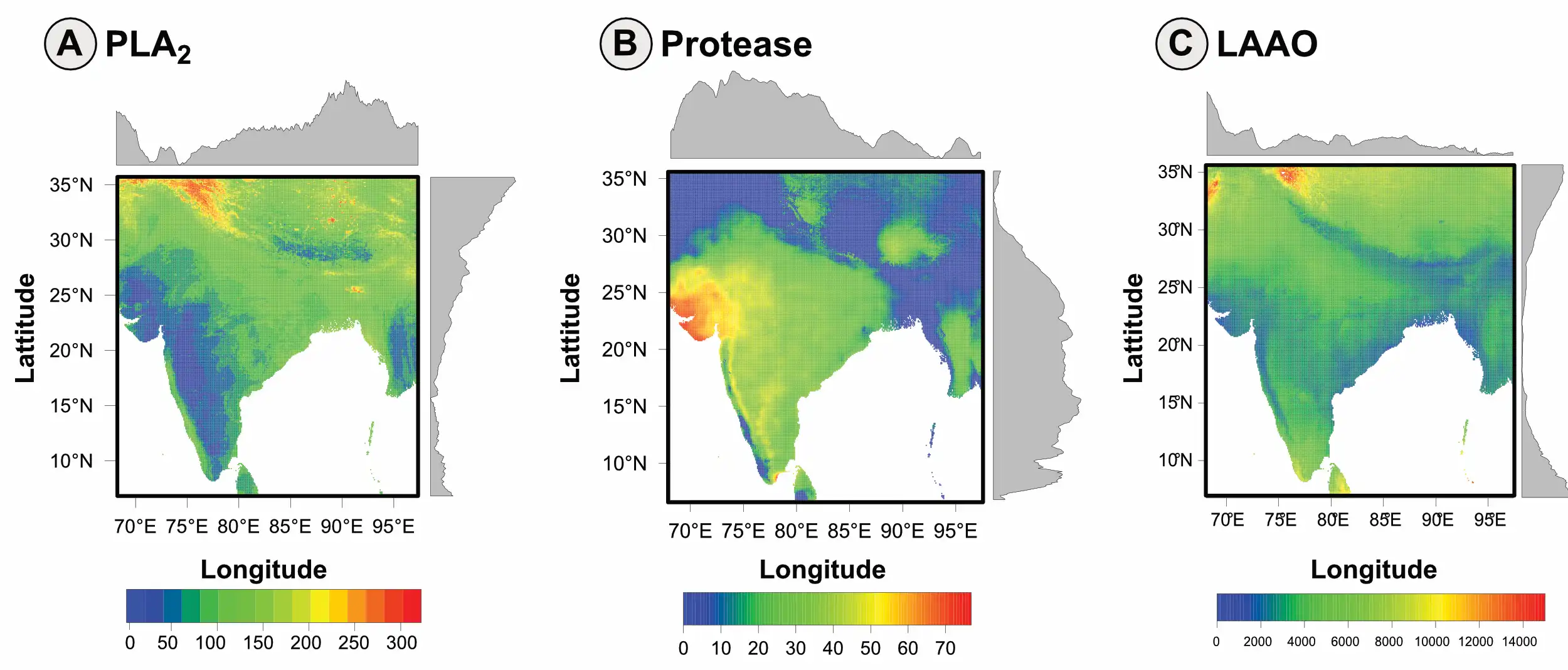
Instead, venom responds to the complex, combined effects of multiple ecological forces. We found the strongest relationship in the tissue-destroying proteases. Nearly half of the variation we saw in these toxins could be explained by specific combinations of temperature and rainfall. PLA2 activity also showed a clear, though slightly weaker, connection to climate, while LAAO activity remained largely uniform across the country.
Venom is not controlled by a single weather switch. It is written by an interplay between environmental factors.
Armed with this data, we were able to build predictive venom maps for places where no venom had ever been collected. These maps suggest that the dry, northwestern regions of India are likely to harbour vipers with highly tissue-destructive, protease-heavy venom, while vipers along the eastern and western coasts may pack venom heavily loaded with muscle-damaging PLA2 toxins.
Why This Matters for Snakebite
Russell's vipers are responsible for nearly half of India's snakebite cases. This is the most clinically relevant snake species as it causes more deaths and disabilities than any other species, anywhere in the world. But if their venom is not identical across the country, our treatments should not be either.
This kind of ecological variation matters a great deal for treatment. If particular venom components dominate in particular regions, we can eventually tailor therapies to match. Next-generation treatments, such as recombinant monoclonal antibodies or targeted small-molecule inhibitors, may not need to be rolled out everywhere at once. They could instead be prioritised in the regions where their target toxins are most common (see 'A Pill Against Snakebite?').
So venom is not dictated by climate, or by genes, or by diet on their own. It emerges from all of these forces acting together, and every Russell's viper carries a record of its environment inside its venom.
As the climate keeps shifting, understanding these ecological influences is more than an evolutionary puzzle. It is part of building better and safer treatments for one of the oldest public health problems humans face.
Comments